
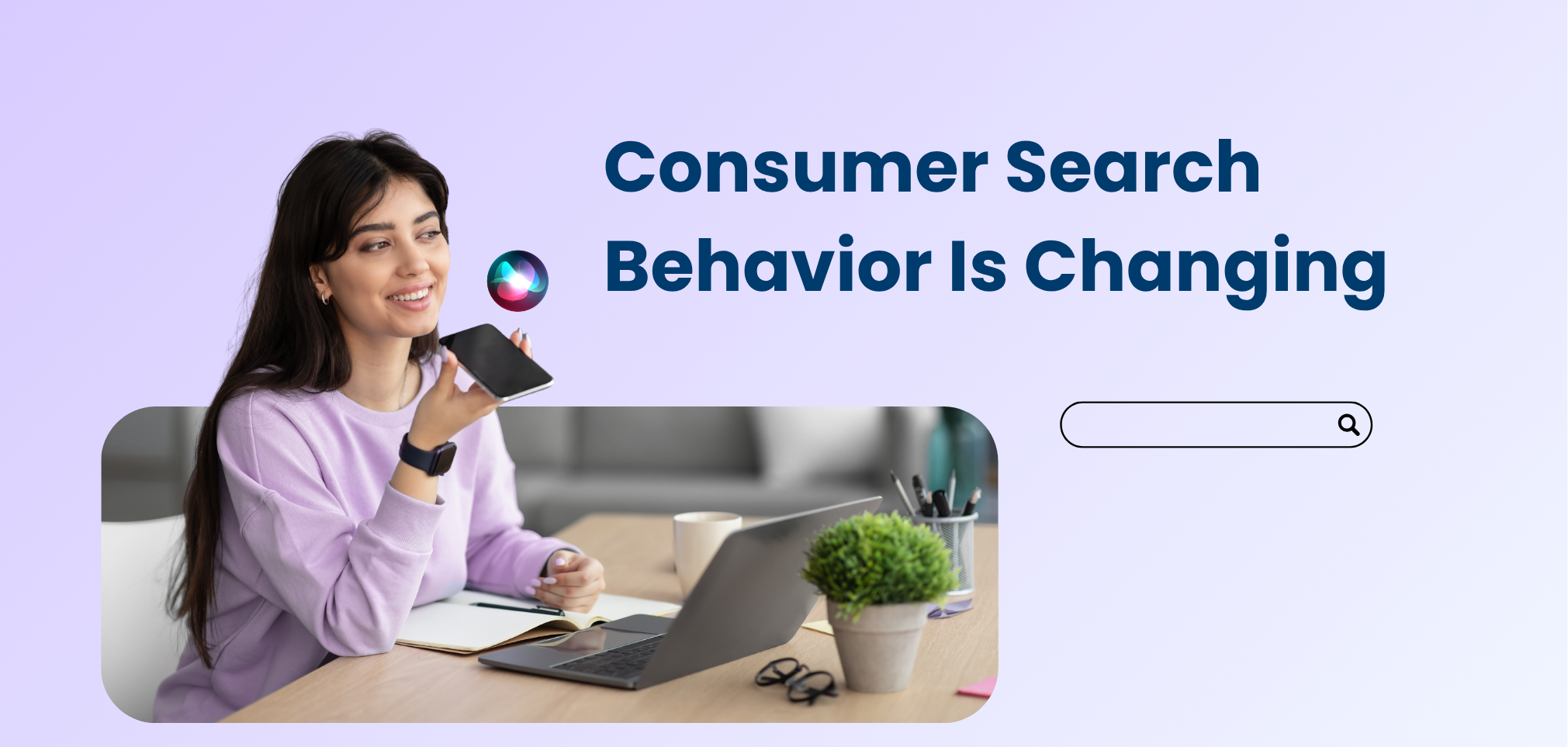
Consumer search behavior has shifted more in the last three years than in the previous decade.
AI-powered search, voice-activated questions, Zero-click results, “Near me now” queries. Customer preferences are changing faster than most businesses can update their websites.
Your customers aren’t just searching differently; they’re choosing, trusting, and buying differently.
If it feels like online marketing has transformed overnight, that’s because it has.
But here’s the good news:
When you understand how consumers are searching today, you can dramatically improve your local SEO, increase visibility on Google, and convert more searchers into customers – before your competition even enters the picture.
Let’s break down what changed, why it matters, and how your business can stay ahead.
-
- The New Customer Journey Starts – and Often Ends – on Google
- Searches Have Become Conversational (Thanks to AI)
- Near Me” Searches Are Exploding – and Getting More Specific
- Mobile Search Is Dominating Decision-Making
- Customers Want Proof – Not Promises
- Where Consumers Are Actually Searching Today
- What Actions Consumers Take During Local Business Research
- What These Shifts Mean for Your Business
- Stay Ahead of Consumer Search Behavior with Consumer Fusion
The New Customer Journey Starts – and Often Ends – on Google
Before a customer calls, visits, or clicks “Book Now,” they’re on Google evaluating options.
A few eye-opening stats:
- 68% of all online experiences start with a search engine
- The average business receives 1,260+ actions per month directly from its Google Business Profile
- 70% of customers choose a business directly from Google results
- Many customers decide without ever visiting a website
This means your Google My Business listing is no longer just a directory listing.
It’s your homepage, reputation page, and conversion engine wrapped into one.
And what drives conversions?
Positive reviews, accurate information, and a strong local SEO presence.
Understanding how consumers search is step one.
Searches Have Become Conversational (Thanks to AI)
Search isn’t keyword-based anymore; it’s human. Customers now talk to Google, Siri, and Ask Maps the same way they’d ask a friend for a recommendation. AI then recommends businesses based on trust signals pulled from your reviews, listings, accuracy, and content.
This shift has created a new competitive landscape where how well you maintain your online presence determines whether AI chooses you.
Gone are the days when people typed in “dentist near me.”
Now consumers talk to Google the way they talk to people:
- “What’s the best dentist near me that takes walk-ins?”
- “Affordable hairstylist open today with great reviews?”
- “Who can fix my AC fast and not overcharge me?”
- “Highly-rated Italian food near me that’s family-friendly?”
And AI like Google SGE, Ask Maps, and voice assistants answer with instant summaries pulled from your:
- Reviews
- Photos
- Categories
- Business information
- Relevance
- Responsiveness
Local SEO today is more than keywords; it’s about context, trust, and conversation.
✔ What this means for your business:
To get recommended by AI, you need:
- Fresh positive reviews
- Fast review responses
- Updated Google categories
- Complete business information
- High-quality photos
- Accurate service descriptions
AI prioritizes trusted businesses in local search – and trust is built online.
“Near Me” Searches Are Exploding – and Getting More Specific
Consumers don’t just want “a business.”
They want the right business, at the right time, in the right place.
Local search has become hyper-personalized. People aren’t looking for generic businesses; they’re searching for the perfect match for their exact need, in their exact moment. That means relevance, completeness, and reputation now matter just as much as your physical location.
If your business doesn’t clearly communicate what you offer, you won’t appear in the searches that matter.
Examples:
- “Best massage near me open now”
- “Emergency plumber near me with good reviews”
- “Dog-friendly cafe near me with wifi”
Google uses three primary factors to decide who ranks:
⭐ Proximity
How close you are to the searcher
⭐ Relevance
Does your business match the intent?
⭐ Prominence
Do you have strong reviews, accurate information, and active engagement?
You can’t control proximity.
But you can control the other two.
✔ What this means for your business:
- Add correct categories
- Use detailed service descriptions
- Upload new photos every month
- Update holiday and seasonal hours
- Make sure reviews reference keywords naturally
Local SEO is a strategy – not a set-and-forget task.
Reviews Are Now the Deciding Factor (More Than Price or Location)
Customers rely on reviews more than ever before. Ratings, recency, legitimacy, and your responses all influence whether someone chooses you or keeps scrolling. Reviews don’t just tell customers what past visitors think; they tell Google whether to rank you at all.
Your review strategy has officially become your revenue strategy.
Consumers trust reviews more than ads, websites, and brand messaging.
- 93% read reviews before choosing a local business
- 82% trust them as much as personal recommendations
- A single negative review can cost you 30 customers
- Responding to reviews = 35% more revenue on average
Consumers don’t just check your star rating; they read how you respond.
✔ What this means for your business:
- Ask for positive reviews consistently
- Respond to all reviews (even positive ones!)
- Remove illegitimate or harmful reviews
- Use AI tools to stay on top of feedback
- Monitor customer sentiment
Your review strategy is your reputation strategy.
And your reputation strategy powers your local SEO.
Mobile Search Is Dominating Decision-Making
More than 60% of all searches now happen on mobile, and customers make decisions fast.
Most customers browse on mobile devices while they’re already on the move. That means decisions happen fast, and your listing needs to keep up. If your Google Business Profile isn’t visually appealing, accurate, and optimized for mobile users, your competitors are only one tap away.
Mobile-first is no longer optional – it’s essential for modern local SEO.
If your listing isn’t:
- Mobile-friendly
- Accurate
- Clean
- Visually appealing
- Easy to read
…customers move on.
✔ What this means for your business:
Your Google Business Profile needs:
- High-quality photos
- Review activity
- Updated hours
- Correct location
- Fast response times
- Clear descriptions
Mobile-first isn’t optional – it’s essential.
Customers Want Proof, Not Promises
Today’s consumer has a “show me” mentality. They want real photos, real reviews, real experiences, and real transparency. Traditional marketing language doesn’t impress them; authenticity does. Visual content and social proof now shape trust faster than anything else.
Consumers want to see what makes you good.
They look for:
- Positive reviews
- Real customer photos
- Behind-the-scenes content
- Before-and-after images
- Accurate business information
- Social media consistency
Your online presence is your first impression.
✔ What this means for your business:
Show – don’t tell.
- Upload photos monthly
- Respond publicly to feedback
- Maintain consistent branding
- Share customer stories
- Keep all listings accurate
Authenticity is the new currency in online marketing.
Where Consumers Are Actually Searching Today
(And Why Local Search Matters More Than Ever)
Google is the biggest player in local discovery, but it’s far from the only one. Customers hop between search engines, maps, AI tools, social media, and directories before making a decision. To earn their trust, your business must be visible and consistent across every touchpoint.
If you think customers are only finding you on Google – think again.
Consumers use multiple platforms across the buyer journey.
Here are the biggest ones:
A. Search Engines (Google Dominates)
- 88% of local searches happen on Google
- 46% of all searches have local intent
- 78% of local mobile searches lead to a purchase within 24 hours
✔ What this means:
Google Business optimization is non-negotiable.
B. Maps Platforms
(Google Maps, Apple Maps, Waze)
- Over 1 billion monthly users on Google Maps
- 1 in 5 local searches begin in a maps app
Maps are search engines now.
✔ What this means:
Your map pin MUST be accurate.
C. Social Media (TikTok, Instagram, Facebook)
- 64% of Gen Z uses TikTok as a search engine
- 54% of consumers use Facebook to research local businesses
- Instagram searches for businesses continue to grow rapidly
✔ What this means:
Your social presence is part of your local SEO ecosystem.
D. AI Assistants
(Ask Maps, SGE, ChatGPT, Siri, Alexa)
- Over 50% of all searches are conversational
- AI is far more likely to recommend a business with tangible results (reviews).
✔ What this means:
Reviews + accurate info = AI trust signals.
E. Online Directories
(Google, TripAdvisor, Angi, Healthgrades, etc.)
- 94% of consumers used an online directory to find information about a new or previously used business
- Directory accuracy impacts local SEO ranking factors (directories that matched their title to the listings’ GBP had a 47%-65% improvement in their ranking position.)
✔ What this means:
Your information must match across every platform.
What Actions Consumers Take During Local Business Research
(and Why Every Step Matters)
Consumers don’t just search – they research.
Once customers discover you, the real decision-making journey begins. They compare, verify, cross-check, and validate before choosing a business. These micro-actions determine whether someone becomes a customer or slips away unnoticed.
Understanding these behaviors helps your business optimize every moment in the customer journey.
Here’s what they do before choosing a business:
⭐ 1. Look at Reviews
This is ALWAYS the first step.
- Read reviews
- Evaluate recency
- Look for patterns
- Check how you respond
Reviews = credibility.
⭐ 2. Check Business Information
Consumers double-check:
- Hours
- Location
- Phone number
- Services
- Photos
64% of people avoid businesses with inaccurate listings.
⭐ 3. Plan Their Route
Mapping the route is part of choosing.
Wrong map pin = lost customers.
⭐ 4. Continue Researching Options
Consumers comparison-shop across:
- Social media
- Directories
- Competitor listings
You must look strong everywhere.
⭐ 5. Make an Inquiry, Booking, or Reservation
Most conversions now happen on Google, NOT your website.
⭐ 6. Look You Up on Other Channels
Consumers cross-check:
- TikTok → Google
- Instagram → Google
- Facebook → Google
- Other lsitings → Website
- Directories → Maps
Consistency builds trust.
Inconsistency kills it.
What These Shifts Mean for Your Business
Modern consumers expect speed, accuracy, transparency, and trust at every touchpoint. These search behavior shifts mean your business needs to be present, polished, and proactive online. Local SEO, positive reviews, accurate listings, and strong visuals are now the foundation of customer acquisition.
If you’re not optimizing your presence across platforms, your competitors are and customers will notice.
Today’s consumers are:
- Impatient
- Informed
- Tech-savvy
- Review-dependent
- Mobile-first
- AI-influenced
Your business must meet them where they’re searching – and where they’re deciding.
This requires:
- Strong local SEO
- Positive reviews
- Accurate listings
- Responsive communication
- High-quality visuals
- Cross-platform consistency
If you’re not doing these things, your competitors are.
Stay Ahead of Consumer Search Behavior with Consumer Fusion
Consumer Fusion helps you stay visible, trusted, and chosen – no matter how search behavior evolves.
With our all-in-one platform, you can:
- Optimize your Google Business profile
- Boost local SEO effortlessly
- Generate more positive reviews
- Remove fake or harmful reviews
- Respond to reviews with AI
- Monitor sentiment across platforms
- Keep all listings accurate and updated
👉 Book a demo to see how Consumer Fusion helps you stay ahead – and turn searchers into loyal customers.
Let’s make your business the one customers choose first.