







As 2025 comes to a close, many businesses are reflecting on what actually drove growth this year. New customers. Repeat business. Increased revenue. Stronger brand trust.
For many, the answer comes back to one powerful factor: online reputation management.
Whether you actively focused on it or not, your reputation influenced how customers found you, trusted you, and chose you throughout 2025. Your online reviews, your star rating, your visibility on Google, and the accuracy of your business information all played a role in your success or quietly held you back.
As we head into 2026, one thing is clear:
👉 Reputation is no longer a “nice-to-have.” It’s a revenue driver.
Table of Contents
-
- Why Online Reputation Management Matters More Going Into 2026
- The New Reality: 4 Stars Is Average in 2026
- Your 2025 Reputation Will Set the Tone for 2026
- Reputation Isn’t Just Reviews, It’s a System
- The Hidden Cost of “Good Enough” Reputation
- What High-Performing Brands Did Differently in 2025
- Why December Is the Most Strategic Time for a Year-End Reputation Audit
- Reputation, Local SEO, and AI Are Now Interconnected
- End 2025 Strong. Start 2026 Stronger.
- Take the First Step: Request Your Year-End Reputation Audit

Why Online Reputation Management Matters More Going Into 2026
Consumer behavior has shifted dramatically over the past few years, and 2025 solidified those changes.
Today’s customers:
- Discover businesses through Google search and Maps
- Trust Google reviews more than ads or brand messaging
- Compare multiple businesses in seconds
- Expect accurate information everywhere they search
- Rely on AI-powered recommendations influenced by reputation signals
We saw trends in 2025, and they are only going to get stronger in 2026. Online reputation management is directly tied to local SEO, visibility, and conversions. Businesses with stronger reputations don’t just look better; they show up more often, get clicked more frequently, and earn more trust.
Looking ahead to 2026, the brands that win won’t be the loudest.
They’ll be the most trusted.

The New Reality: 4 Stars Is Average in 2026
For years, businesses aimed for a 4-star rating and considered it a success. That benchmark has officially changed.
In today’s competitive search landscape:
- 4 stars is average
- Customers increasingly choose businesses rated 4.5 stars or higher
- Review recency and responsiveness matter more than total volume
- Even small rating drops can significantly impact revenue
✔ Here’s why this matters:
- Every 1-star drop can result in a 5–10% loss in revenue
- Businesses with higher ratings earn more clicks, even if they rank lower
- Strong positive reviews increase both trust and local search performance
This shift is why businesses are rethinking their reputation management strategy and treating Google Business Profile optimization as a core growth priority.
Your 2025 Reputation Will Set the Tone for 2026
Whether you realized it or not, the habits you built in 2025 created momentum or friction heading into the new year.
Ask yourself:
- Did we consistently ask for and generate positive reviews?
- Did we respond to all customer feedback in a timely, professional way?
- Did we remove illegitimate or harmful reviews?
- Did every location reflect the same brand experience?
- Was our Google Business Profile accurate and up to date?
- Did we use review insights to guide operational decisions?
These choices didn’t just affect perception. They influenced local search visibility, click-through rates, and customer confidence.
Effective online reputation management ensures that your brand enters 2026 with trust, clarity, and consistency already in place.
Reputation Isn’t Just Reviews, It’s a System
One of the biggest mistakes businesses made in 2025 was treating reputation as a single metric.
Reputation isn’t just your star rating.
It’s a system.
A strong business reputation includes:
- Review quality, volume, and recency
- Response speed and tone
- Accuracy of your Google Business Profile
- Consistency across locations and directories
- Visibility in Maps and local results
- Customer sentiment trends over time
- Alignment across all online marketing channels
When one part of this system breaks, the entire customer experience weakens and search engines take notice.
That’s why modern online reputation management is proactive, not reactive.

Many businesses ended 2025 thinking, “We’re doing fine.”
But “fine” doesn’t compete in 2026.
Here’s what “good enough” often looks like behind the scenes:
- Old negative reviews still influence decisions
- Slow or inconsistent review responses
- Listings are slightly out of sync across platforms
- Location-level performance gaps are hurting brand trust
- Missed opportunities to convert happy customers into advocates
Without a clear reputation management strategy, these small issues quietly erode local SEO performance and revenue over time.
Meanwhile, competitors who invested in reputation systems are ranking higher, earning more clicks, and converting customers faster.
The biggest risk isn’t bad reviews, it’s inaction.
Read our blog on “Why Customer Reviews Are Important”
What High-Performing Brands Did Differently in 2025
Brands positioned for success in 2026 didn’t leave reputation to chance.
They:
- Audited their reputation regularly
- Actively removed illegitimate or policy-violating reviews
- Responded consistently across all locations
- Generated fresh reviews to maintain recency
- Used sentiment data to identify trends and issues
- Ensured listings were accurate everywhere customers searched
- Scaled efforts with automation and AI
They treated online reputation management as a long-term growth lever, not a clean-up task.
Why December Is the Most Strategic Time for a Year-End Reputation Audit
December is one of the most powerful and overlooked moments for reputation strategy.
A year-end reputation audit helps businesses:
- Review a full year of performance data
- Identify strengths and weaknesses before Q1
- Fix visibility gaps before rankings carry over
- Capitalize on holiday traffic without risking trust
- Enter 2026 with a clear plan
This audit answers critical questions:
- Are our reviews helping or hurting visibility?
- Which locations are underperforming?
- Are we responding fast enough?
- Are our listings accurate everywhere?
- Where are growth opportunities hiding?
You can’t plan growth without clarity, and clarity starts with insight.
Reputation, Local SEO, and AI Are Now Interconnected
As AI-powered search continues to evolve, online reputation management plays an even larger role.
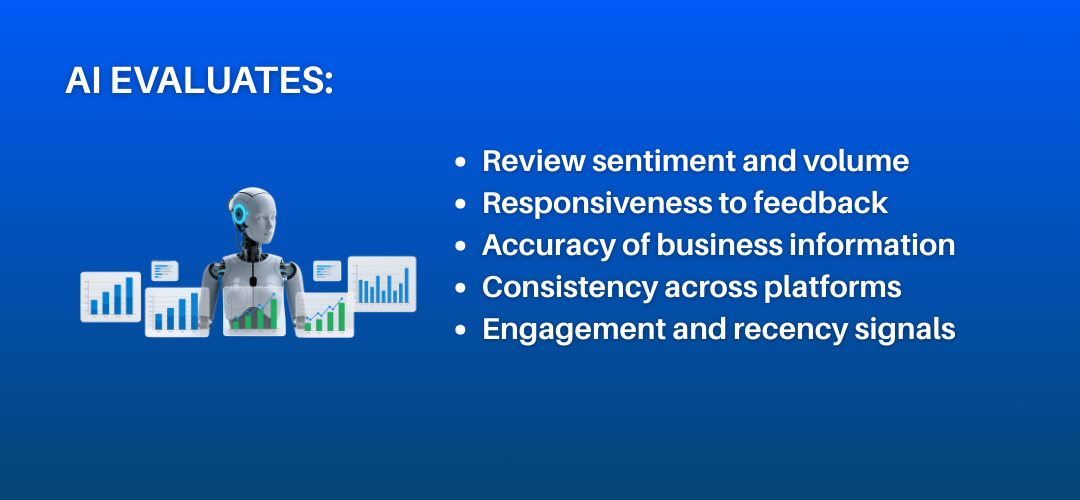
AI evaluates:
- Review sentiment and volume
- Responsiveness to feedback
- Accuracy of business information
- Consistency across platforms
- Engagement and recency signals
Businesses with strong reputations and accurate listings are more likely to be recommended by AI-driven tools like Google SGE and Ask Maps.
Reputation is no longer just for customers, it’s for algorithms, too.
End 2025 Strong. Start 2026 Stronger.
Your reputation worked every day in 2025, whether you actively managed it or not.
The question now is simple:
Will your online reputation management strategy help you grow in 2026 or quietly help your competitors instead?
This is the moment to reflect, assess, and prepare.
🎯 Take the First Step: Request Your Year-End Reputation Audit
Before the year ends, get a clear view of how your reputation is performing.
A Year-End Reputation Audit helps you:
- Understand your current standing
- Identify risks before they impact revenue
- Improve local SEO and visibility
- Strengthen trust across all locations
- Start 2026 with confidence and momentum
At Consumer Fusion, we help thousands of businesses manage reviews, visibility, and brand trust across Google and local platforms.
👉 Request your Year-End Reputation Audit today
End 2025 strong.
Start 2026 stronger with a reputation working for you.

How Consumer Search Behavior Is Changing (and What Your Business Needs to Do About It)
Consumer search behavior has shifted more in the last three years than in the previous decade.AI-powered search, voice-activated questions, Zero-click results, “Near me now” queries. Customer preferences are changing faster than most businesses can update their...

5 Review Mistakes That Are Quietly Hurting Your Business (and How to Fix Them)
Let’s be honest, Google Business reviews (or any reviews) can make or break your business. Before a customer ever calls, books, or clicks “Add to Cart,” they’re scrolling through your online reviews. And what they see determines if they trust you… or move on to your...

Google Business Q&A: Why It’s Going Away and What’s Replacing It
For years, the Google Business Q&A feature has been a quiet MVP for local businesses. It gave customers an easy way to ask things like: “Do you take walk-ins?” “Is parking free?” “Do you offer vegan options?” And it lets the business reply directly on their Google...
Simplify Your Reputation Management
Learn why so many brands trust us for Reputation Management
By submitting this form, you agree to receive our marketing emails and you are consenting to be contacted by SMS text message. By using this site you also agree with our use of cookies. Learn more.